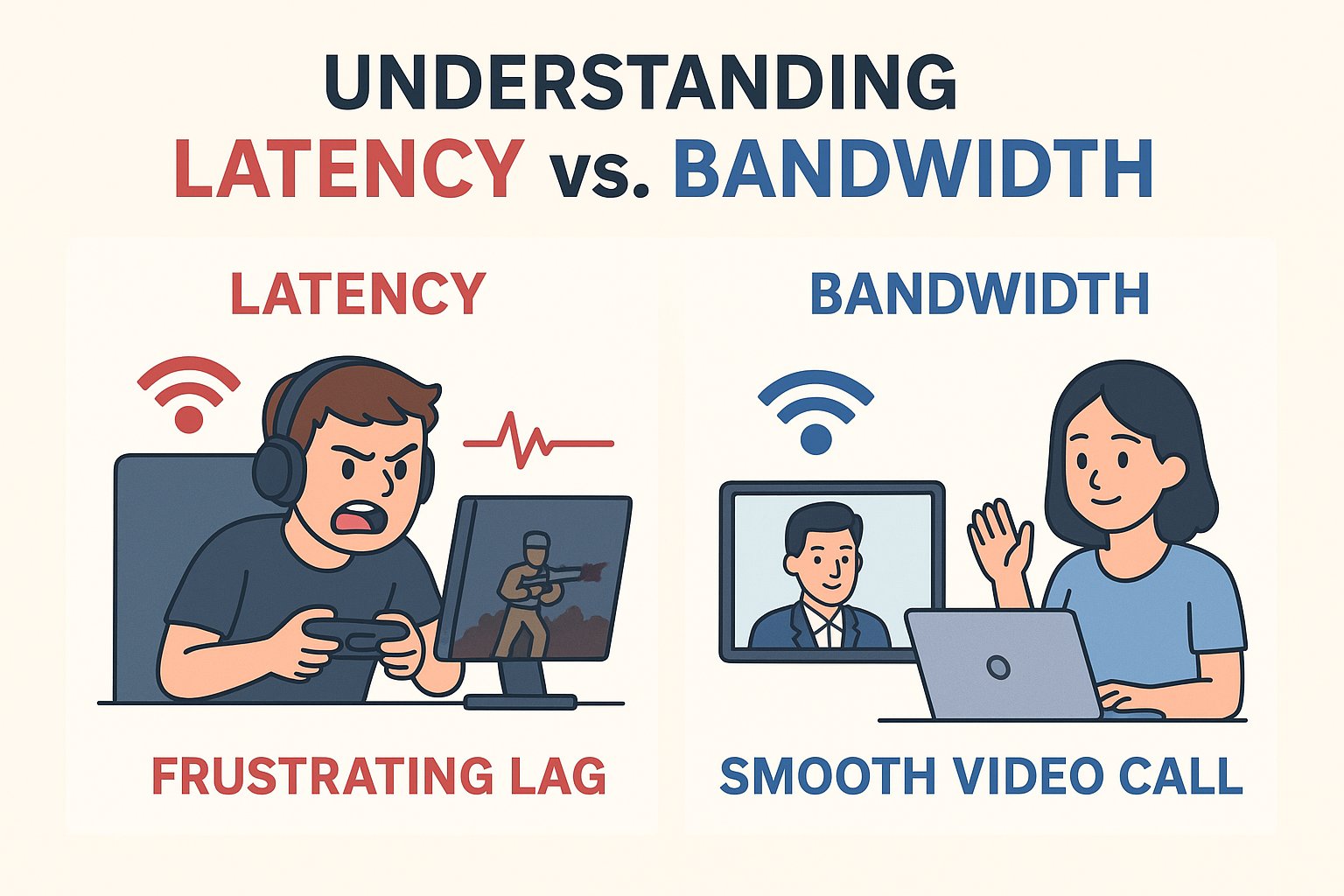
As someone from South Australia, I’m all too familiar with the frustration of lag during a heated online gaming session or a critical video call that freezes at the most inconvenient moment. These issues arise from two crucial but often misunderstood aspects of internet performance: latency and bandwidth. Understanding “Latency vs. Bandwidth” is essential for anyone who relies on a stable internet connection, be it for gaming, streaming, or working from home.
What is Bandwidth?
Bandwidth refers to the maximum amount of data that can be transferred over your internet connection in a given time. Think of it like a highway: the wider the highway, the more cars (or data) can travel at the same time. It’s measured in bits per second (bps), with common units being kilobits, megabits, and gigabits (Mbps, Gbps). For activities like streaming HD videos or downloading large files, higher bandwidth is beneficial because it allows more data to flow smoothly at once.
- High Bandwidth: Ideal for data-heavy activities such as streaming high-definition videos and downloading large files without buffering.
- Low Bandwidth: Can result in slower speeds and interruptions like buffering during video streaming or lower quality video calls.
What is Latency?
Latency is the time it takes for data to travel from your device to a server and back again, measured in milliseconds (ms). Imagine it’s like the time it takes for your command in a game to reach the gaming server and come back with a response. While bandwidth affects how much data your internet can handle at a time, latency affects how quickly that data travels. For gamers and those on video calls, low latency is crucial as it significantly impacts real-time interaction.
- Low Latency: Necessary for real-time applications like video calls and online gaming, ensuring quick response times and minimal delays.
- High Latency: Can lead to lag, delays in gameplay, and poor performance in real-time communication.
How Are Bandwidth and Latency Measured?
Measuring Bandwidth
Your bandwidth can be tested by measuring the maximum bitrate your connection can achieve. Tools like speed tests assess download and upload speeds to give you an idea of your current bandwidth.
Measuring Latency
Latency is typically measured using a ping test. This involves sending a signal to a server and measuring the time it takes for the response to return. A lower ping time, say under 50 ms, is considered good for gaming and video calls.
The Impact of Bandwidth and Latency on Different Applications
Gaming
For online gamers in South Australia, both bandwidth and latency are critical. While you need sufficient bandwidth (a minimum of 5 Mbps for downloads and 3 Mbps for uploads), latency is often the game-changer. High latency can lead to frustrating lag and poor response times, so keeping latency under 50 ms can significantly enhance your gaming experience.
Video Calls and Meetings
In this era of remote work, video calls have become a staple. High bandwidth allows for high-resolution video, but it’s low latency that ensures calls don’t freeze or desynchronize. Real-time interaction demands a combination of both for smooth, professional call quality.
Streaming
While not as sensitive to latency as gaming or video calls, streaming still benefits from a well-rounded connection. High bandwidth ensures your favourite shows stream in 4K without buffering, and while latency isn’t as critical, lower latency can reduce initial buffering times.
Browsing
General web browsing doesn’t require high bandwidth, but low latency can make your internet feel significantly faster, with quicker page loads and more responsive websites.
Smart Home and IoT Devices
With more Aussies adopting smart home technology, both bandwidth and latency play a role in performance. Devices like security cameras and smart speakers require sufficient bandwidth to communicate effectively, and low latency ensures timely responses to commands and real-time monitoring.
How Bandwidth and Latency Affect User Experience
Real-Time Communication (RTC)
RTC applications, whether for video calls or gaming, are more dependent on latency than bandwidth. Having low latency is essential to maintaining the flow of conversation or gameplay, where even a slight delay is noticeable.
Network Throughput
Network throughput is the actual data successfully transferred over your network. It relies on both bandwidth and latency. High throughput requires a balance of both, as even a high bandwidth connection can falter if the latency is equally high.
Practical Tips to Optimize Both Bandwidth and Latency
To make the most of your internet, understanding and optimizing both bandwidth and latency is key. Here are some tips:
- Update Hardware Regularly: Keep your routers and modems up to date to support the latest speeds and technologies.
- Monitor Network Usage: Watch the number of connected devices and manage them to prevent congestion.
- Choose the Right Internet Plan: Make sure your plan fits your usage needs, considering both data volume and speed requirements.
- Use Wired Connections: When possible, use Ethernet for more stable and lower-latency connections compared to Wi-Fi.
- Use Speed Testing Tools: Regularly test your internet speed to identify and address issues promptly.
- Reduce Network Congestion: Limit heavy usage during peak times to avoid slowdowns.
Conclusion
So there you have it, folks. Understanding the differences between “Latency vs. Bandwidth” is crucial for anyone who spends a significant amount of time online – whether for work, play, or pure old entertainment. By grasping these concepts and taking steps to optimize your connection, you’ll enjoy smoother and faster internet performance, making those victorious gaming moments or cohesive work meetings possible without the stress of technical disturbances.